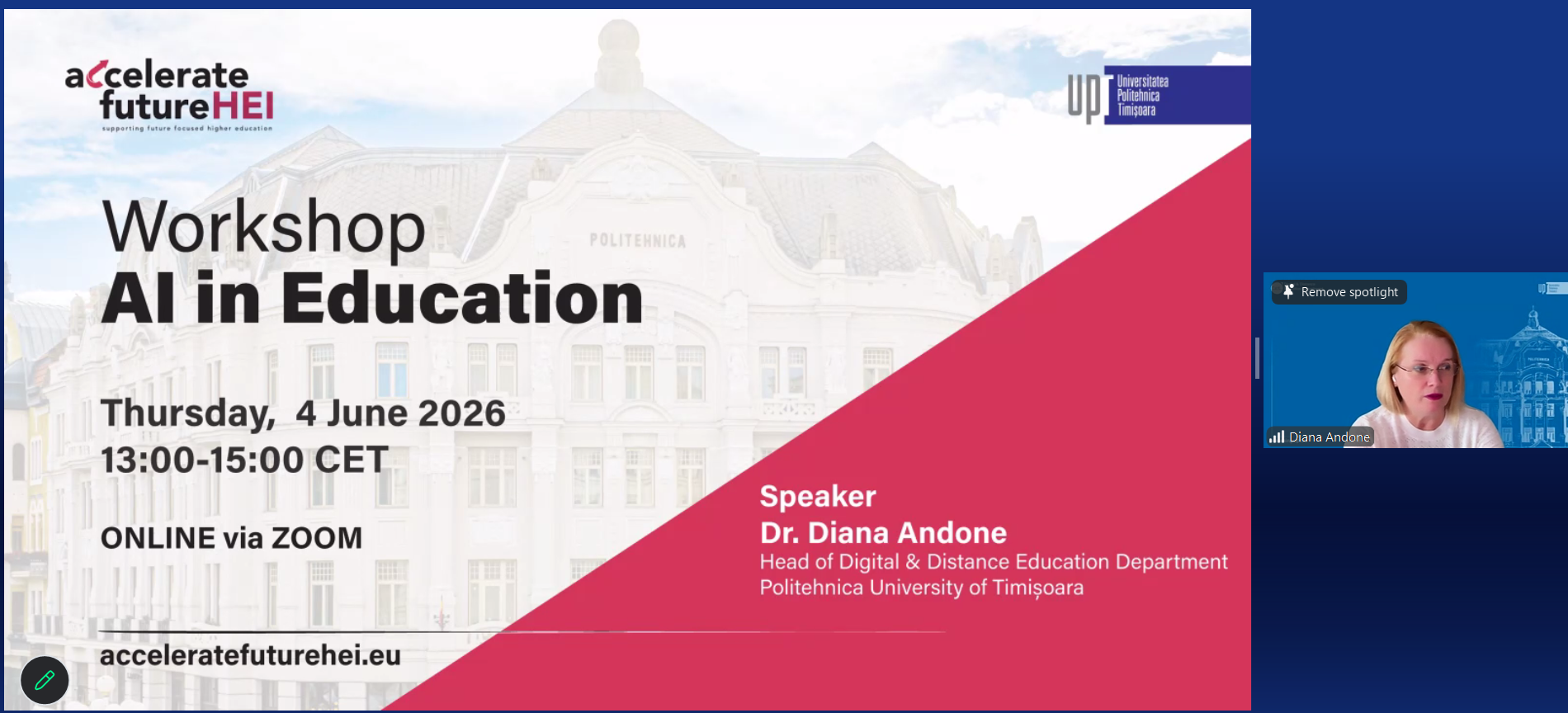
Politehnica University of Timișoara (UPT), through its Digital and Distance Education Department (DeL), successfully organised a series of two free international webinars on the responsible use of Artificial Intelligence in higher education and research, as part of the European project Accelerate Future HEI, gathering hundreds of participants from over 10 countries.
Both sessions were delivered by Dr Diana Andone, Director of the Digital and Distance Education Department at UPT, an internationally recognised expert with over 30 years of experience in digital technologies and online learning.
Workshop 1: AI in Education
The first session, on June 4th, brought together over 70 participants from Romania, Belgium, Italy, Spain, Latvia, Ukraine, Portugal and Austria, who explored together a two-hour exploration of the responsible integration of AI in higher education. Dr Andone presented the UNESCO recommendations on the use of AI in education, a practical framework enabling anyone to use AI tools regardless of technical background, and strategies for writing effective prompts to obtain better results from AI systems.
The session generated engaged participation, with attendees sharing their own experiences and practices both through the Q&A and chat sections via Zoom, where some participants shared how they use different AI tools to support course design and student learning, others asked dozens of questions and offered feedback, while almost all participants voted on different topics live, via the Mentimeter app.
Workshop 2: AI in Research
The second session, on June 11th, brought together over 40 participants under the coordination of Dr Diana Andone (Head of the Digital & Distance Education Department, UPT) and focused on how artificial intelligence is transforming academic research within the Accelerate Future HEI project. The webinar analysed the transition of the documentation process from rigid searches in the “Pre-GenAI” era to the “With GenAI” era, a technology that enables literature reviews 40–60% faster and cross-language correlations.
To streamline interaction with these tools, the session detailed the pillars of the right mindset for crafting prompts (The Prompting Mindset): defining AI’s role, establishing context, setting constraints, and requesting step-by-step reasoning. Fundamental prompt engineering methods (such as Zero-shot or Few-shot Prompting) and development frameworks like the REASONS Canvas, CO-STAR, or CRISPE were presented.
In addition, the webinar addressed ethical use and research integrity, examining key concepts promoted by UKRIO, such as rigour, honesty, transparency, and accountability. Participants were presented with a decision-making framework developed by UNESCO for the safe use of ChatGPT, reviewing major global ethical principles (equity, inclusion, sustainability) and European resources offered through the EU RAISE initiative (access to data, funding, and increased computing capacity through AI Gigafactories).
Both webinars were free and open to academics, researchers, doctoral students, and students across the international university community.